Where did early complex life persist during Snowball Earth glaciations?
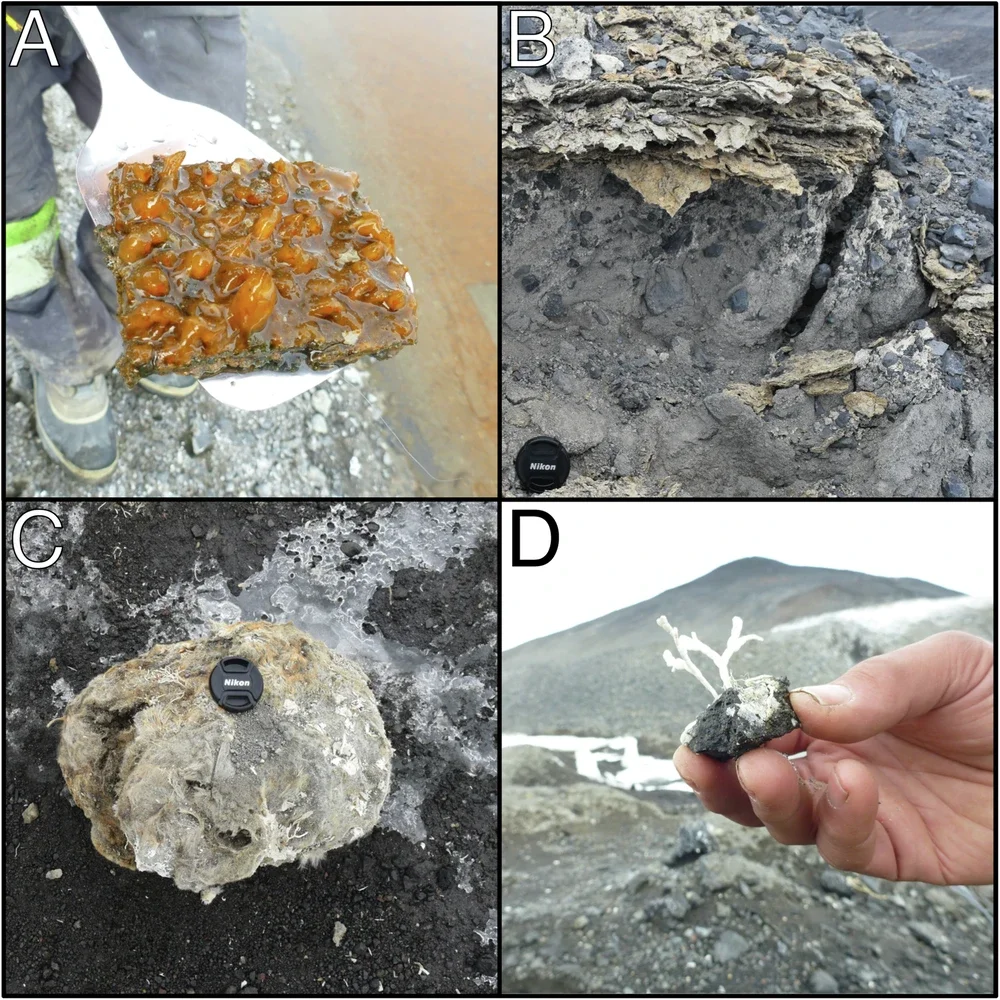
The earliest fossil instances of complex multicellular life on Earth date back to the Ediacaran Period (∼635 to 539 Ma). This period directly follows the Cryogenian Period (∼720 to 635 Ma), during which two planet-scale glaciations took place. Though hypotheses on the extent of ice coverage differ, significant ice cover would have made survival difficult for life at the time, only allowing few organisms to survive. These important organisms were the ancestors of the complex multicellular life found in the Ediacaran Period and onwards. Since the era of global glaciations is long behind us, few environments remain on Earth today that may lend clues about where and how early complex life sheltered and survived during the Cryogenian Period.
The ephemeral meltwater ponds on the surface of Antarctica’s McMurdo Ice Shelf are hypothesized to be possible analogs to above-ice Cryogenian refugia (figure 2 from our paper, showing life around the ice shelf, above). Accordingly, my colleagues and I studied the occurrence, distributions, and activity of eukaryotic multicellular life in these ponds to get a sense of the types of eukaryotes present and whether different eukaryotes lived in different ponds. We examined the eukaryotic communities using two independent methods: 18S rRNA gene analysis and sterol lipid analysis.
18S rRNA Gene Analysis
My colleagues and I examined the 18S rRNA genes from each pond — this type of genetic analysis is commonly used to characterize eukaryotic organisms in environmental samples. Our 18S rRNA gene analysis revealed the broad presence of the major eukaryotic groups; however, it also revealed that in most of the ponds, a significant proportion of the community was uncategorizable against existing gene reference libraries. In some cases, greater than 50% of the eukaryotic pond community couldn’t be identified past the domain level. This data was deposited in NCBI’s Sequence Read Archive, so it can be re-analyzed in the future once reference libraries have more representation of polar and psychrophilic organisms.
Sterols
Sterols are membrane lipids associated with different groups of eukaryotes. Sterol analysis can transcend the limitations of 18S rRNA gene analysis by enabling the broad classification of eukaryotic groups in modern and ancient organisms alike. Our sterol analyses revealed the broad presence of algae, protists, and meiofauna in each pond. However, according to the sterols, each pond hosted varying proportions of these major eukaryotic groups despite their close proximity, indicating that these ponds support diverse and distinct microbial communities. To take this analyses further and to reveal minor eukaryotic contributions, we conducted simulated diagenesis of the sterols from each pond, which yielded their immature sterane hydrocarbon counterparts. Analyzing the resulting steranes revealed the presence of sponges, dinoflagellates and diatoms, and different algal subgroups — and demonstrated how simulated diagenesis can yield valuable insights towards understanding paleoenvironments that lack traditional fossil evidence.
Considered all together, our findings confirm that this type of above-ice environment is a valid and plausible candidate for possible Cryogenian Period refugia and may have supported the sheltering and diversification of early complex life. Most importantly, this work forms the basis for more organic geochemical examinations of above-ice oases for early complex life!