Carbon isotopes of cyanobacterial lipids
Cyanobacteria are ancient Earth-changing microorganisms — they are responsible for the permanent oxygenation of Earth’s atmosphere, which is a necessary prerequisite for the emergence of complex life. Because of this, their accurate identification in the fossil record is important. However, the fossil remnants of cyanobacteria in rocks and sediments overlap with those produced by other groups of microbes, complicating the accurate source assignment of these molecular fossils in ancient and modern sediments alike. To accurately interpret molecular biosignature assemblages in sediments, additional information that can distinguish between fossil sources is necessary: carbon isotopes. The distribution of carbon isotopes in molecular fossils results from the biosynthetic processes that produced these fossils’ precursor molecules, and different groups of bacteria employ different biosynthetic pathways to produce these precursor molecules. As a result, the analysis of carbon isotopes can help pinpoint the fossil producers. Despite the abundance of cyanobacteria on our planet, little is known about the distribution of carbon isotopes within cyanobacterial lipids and in the molecular fossils they leave behind in the sediments and rocks.
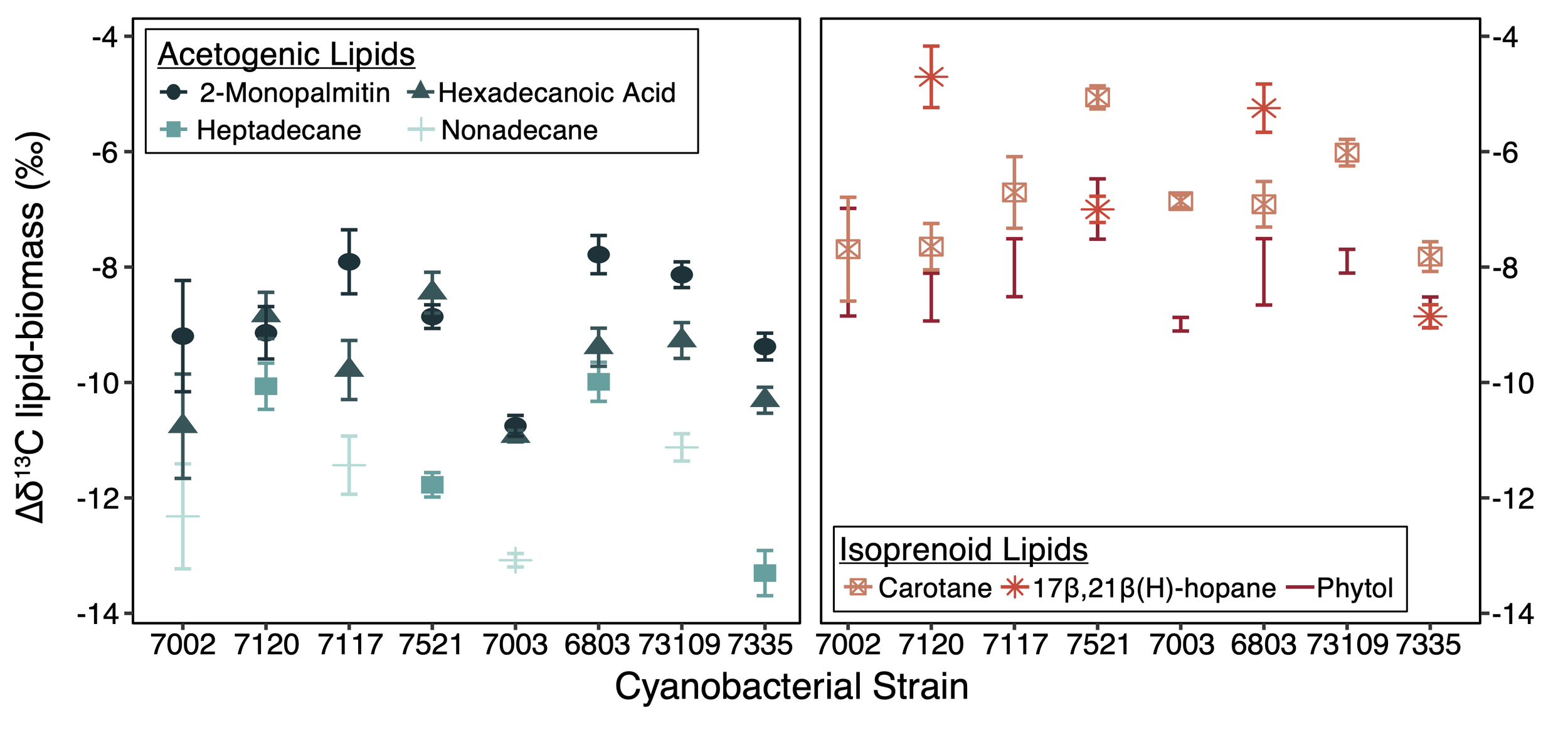
To address this need, my colleagues and I measured the carbon isotopes of a variety of lipids from a diverse assortment of cultured marine and freshwater cyanobacteria. Our measurements revealed a consistent isotopic ordering of cyanobacterial lipids, in which isoprenoid lipids contained relatively more carbon-13 than acetogenic lipids. This finding affirms earlier theoretical predictions, though the consistency of this trend across such a diverse set of cyanobacteria was surprising — meaning that this ordering is the rule, not the exception (figure 2 from our paper, showing this isotope ordering, above). Not only does this insight potentially aid future molecular fossil source assignments, but it will also aid emerging efforts which aim to model carbon isotope systematics in photoautotrophic metabolisms and may provide context for future position-specific carbon isotope analyses.